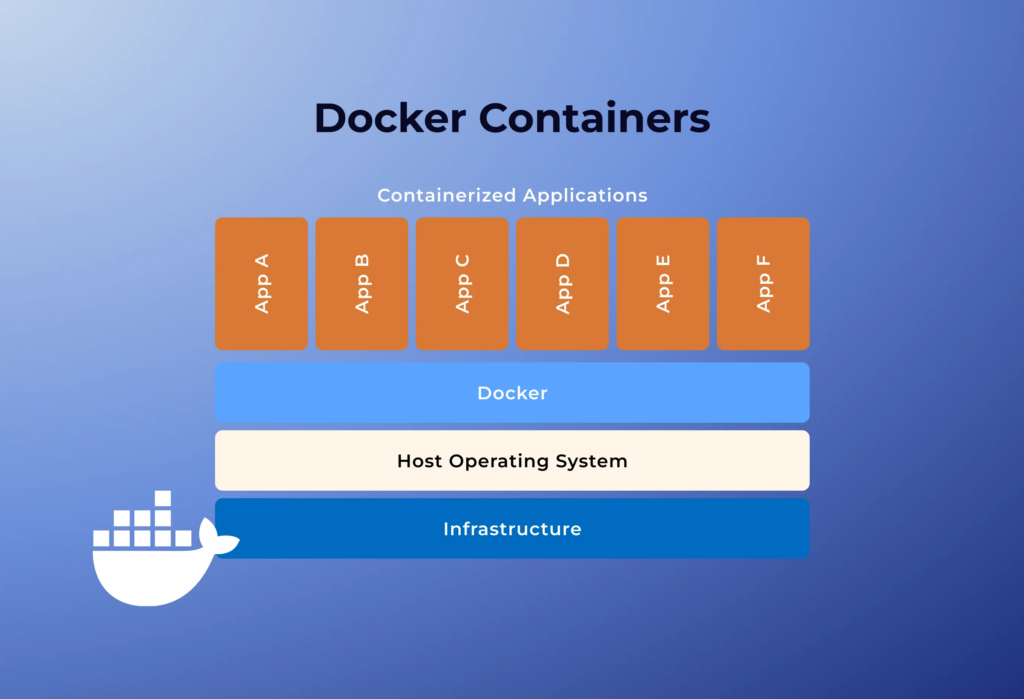
A container is a lightweight, portable way to package an application together with everything it needs to run. It packages the code, runtime, libraries, and system dependencies. Unlike virtual machines, containers do not include a full operating system but instead, share the host system’s OS kernel while remaining isolated from each other.
This makes containers much smaller, faster to start, and more efficient in terms of resource usage compared to traditional VMs.
Docker is the most widely used container platform and popularized containers for everyday development and deployment. With Docker, developers define an application’s environment using a Dockerfile, which acts like a template on describing how the container should be built. Once created, a Docker container can run the same way on a laptop, a cloud server, or a production cluster, solving the classic problem of “it works on my machine but not on yours.”
From a DevOps perspective, containers are a major building block of modern cloud-native systems. They are commonly used to deploy microservices, APIs, and backends because they allow consistent, repeatable deployments and easy scaling. Containers also integrate well with orchestration tools (such as Kubernetes) that manage load balancing, failover, and automated scaling.
References
- Treinetic. A Beginner’s Guide to Docker. Treinetic, https://treinetic.com/a-beginners-guide-to-docker/. Jan. 2026.
- Docker, Inc. What Is a Container? Docker, https://www.docker.com/resources/what-container/. 21 Jan. 2026.
- Red Hat, Inc. Containers Explained: What They Are and Why You Should Care. Red Hat, https://www.redhat.com/en/topics/containers. 21 Jan. 2026.